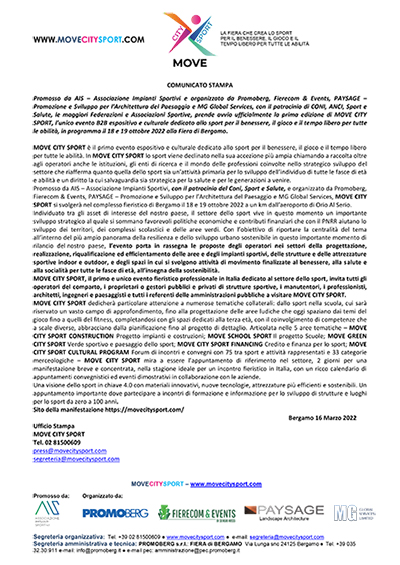

Al via la prima tappa del Road Show di MOVE CITY SPORT, l’unico evento B2B espositivo e culturale dedicato allo sport per il benessere, il gioco e il tempo libero per tutte le abilità, in programma il 18 e 19 ottobre 2022 alla Fiera di Bergamo.
Fissata la prima tappa di avvicinamento a Move City Sport che si svolgerà alla Fiera di Bergamo il 18 e 19 ottobre 2022. Dedicato allo sport per il benessere, il gioco e il tempo libero per tutte le abilità, l’evento espositivo e culturale sarà accompagnato da Forum Internazionali che affronteranno i principali temi legati allo sviluppo dello sport e dell’impiantistica sportiva, nei settori della progettazione, realizzazione, riqualificazione ed efficientamento delle aree e degli impianti sportivi, delle strutture e delle attrezzature sportive indoor e outdoor, e degli spazi in cui si svolgono attività di movimento finalizzate al benessere, alla salute e alla socialità per tutte le fasce di età, all’insegna della sostenibilità. Nel corso di Move City Sport, si svolgerà inoltre il congresso nazionale di EPSI – European Platform for Sport Innovation, l’organizzazione europea che si occupa di finanziamenti a fondo perduto, bandi e progettazione economica europea dedicati al mondo dello sport, adoperandosi per condizioni più favorevoli all’innovazione per l’ecosistema sportivo dell’Unione Europea.
Si svolgerà quindi il prossimo 12 maggio dalle ore 17 il primo incontro del Move City Sport Road Show riservato agli organismi e alle federazioni sportive. Ad aprire l’incontro, Ezio Ferrari – presidente di AIS – Associazione Impianti Sportivi, promotore di Move City Sport, e gli organizzatori Novella Cappelletti – direttore di PAYSAGE – Promozione e Sviluppo per l’Architettura del Paesaggio, Sergio Rossi di Fierecom & Events, Carlo Conte – Direttore Operations di Promoberg srl e Giancarlo de Cristofaro – CEO di MG Global Services.
All’incontro, promosso da Sport e Salute Lombardia, che si svolgerà all’interno del Palazzo delle Federazioni di Milano, sono stati inviati per intervenire:
- Felicia Panarese, Segretario della struttura territoriale – Sport e Salute Lombardia
- Federigo Ferrari Castellani, componente di Giunta CONI LOMBARDIA
- Simone Rasetti, Direttore di Funzione Specialistica Sport, Grandi Eventi Sportivi della Direzione Generale Presidenza – Regione Lombardia
- Martina Riva, Assessore allo Sport, Turismo e Politiche Giovanili – Comune Di Milano
- Giampiera Vismara, Coordinatore Dip. Cultura, Turismo, Giovani, Sport e Olimpiadi 2026– ANCI Lombardia
Ufficio Stampa
MOVE CITY SPORT
Tel. 02 81500609
press@movecitysport.com
segreteria@movecitysport.com
The Mechanics of No Deposit Promotions According to Betzella
The gambling industry has undergone significant transformation over the past two decades, with online platforms revolutionizing how players engage with betting entertainment. Among the most intriguing developments in this digital evolution is the emergence of no deposit promotions, which have fundamentally altered the relationship between operators and potential customers. These promotional mechanisms serve as risk-free entry points for newcomers while simultaneously functioning as sophisticated customer acquisition tools for operators. Understanding the intricate mechanics behind these offers requires examining their structural components, regulatory framework, and the strategic considerations that platforms like Betzella employ when designing and implementing such promotions.
The Structural Framework of No Deposit Incentives
No deposit promotions operate on a deceptively simple premise: operators provide players with bonus credits or free spins without requiring an initial financial commitment. However, the underlying mechanics reveal a complex system of checks, balances, and strategic considerations. These promotions typically consist of three fundamental components: the bonus value itself, the wagering requirements attached to it, and the temporal constraints governing its use.
The bonus value represents the nominal amount credited to a player’s account upon successful registration and verification. This figure varies considerably across the industry, ranging from modest sums of five to ten currency units to more substantial offerings exceeding fifty units. Betzella’s approach to determining this value reflects careful market analysis and competitive positioning, balancing attractiveness to potential customers against the financial sustainability of the promotion.
Wagering requirements constitute the most critical mechanical element of these promotions. These stipulations mandate that players must wager the bonus amount a specified number of times before any winnings become withdrawable. Industry standards typically range from twenty to fifty times the bonus value, though some operators implement even higher multiples. This mechanism protects operators from immediate arbitrage opportunities while still providing genuine winning potential for engaged players. The mathematical probability embedded in these requirements ensures that while some players will successfully convert bonuses into withdrawable funds, the aggregate cost to the operator remains predictable and manageable.
Temporal constraints add another layer of complexity to the promotional mechanics. Most no deposit offers include explicit expiration dates, typically ranging from seven to thirty days from activation. This time limitation serves multiple strategic purposes: it creates urgency that encourages immediate engagement, prevents bonus accumulation across extended periods, and ensures that the promotional liability appears on financial statements for predictable durations.
Verification Protocols and Fraud Prevention
The operational success of no deposit promotions depends heavily on robust verification systems that prevent abuse while maintaining accessibility for legitimate users. The challenge operators face is substantial: these offers inherently attract both genuine potential customers and individuals seeking to exploit the system through multiple account creation or identity fraud.
Modern verification protocols typically employ multi-layered authentication processes. Initial registration requires standard personal information including full name, date of birth, residential address, and contact details. However, the verification extends well beyond simple data collection. Operators implement sophisticated algorithms that cross-reference submitted information against existing databases, identifying patterns that might indicate fraudulent activity. IP address tracking, device fingerprinting, and behavioral analysis all contribute to creating comprehensive user profiles that help distinguish legitimate registrations from suspicious ones.
Document verification represents another crucial component of the fraud prevention framework. While some operators allow immediate bonus activation upon registration, most require players to submit identification documents before withdrawing any winnings derived from no deposit promotions. This approach, which platforms offering https://betzella.com/no-deposit-bonus-betting/ commonly employ, strikes a balance between accessibility and security. Players can begin exploring the platform immediately, but the withdrawal requirement for documentation verification creates a natural checkpoint that deters fraudulent exploitation.
Geographic restrictions add another dimension to the verification process. Licensing requirements and regulatory frameworks vary dramatically across jurisdictions, necessitating location-based eligibility criteria. Operators utilize geolocation technology to verify that registrants reside in permitted territories, automatically excluding individuals from restricted regions. This geographic filtering protects operators from regulatory violations while ensuring that promotional resources target legally accessible markets.
The Economic Logic Behind Risk-Free Offers
From a business perspective, no deposit promotions might appear counterintuitive—why would operators distribute free credits with genuine winning potential? The answer lies in sophisticated customer acquisition economics and lifetime value calculations that justify the initial promotional expenditure.
Customer acquisition costs in the online gambling industry are substantial, with operators frequently spending between one hundred and three hundred currency units to acquire a single depositing customer through traditional advertising channels. No deposit promotions offer an alternative acquisition pathway that, while still costly, provides several distinct advantages. The self-selection mechanism inherent in these offers means that individuals who register specifically for a no deposit promotion have already demonstrated interest in the platform’s offerings, representing warmer leads than those reached through broad advertising campaigns.
Conversion rate optimization represents the true economic justification for these promotions. Industry data suggests that players who engage with a platform through a no deposit offer convert to depositing customers at rates significantly higher than those who merely visit through advertising. This elevated conversion rate stems from several factors: the promotion provides genuine platform experience, reduces the psychological barrier of financial commitment, and creates reciprocity dynamics that encourage subsequent deposits. Betzella’s implementation of these promotions reflects understanding of these conversion mechanics, with promotional terms calibrated to encourage extended engagement that facilitates platform familiarization.
Lifetime value calculations complete the economic picture. While the immediate cost of a no deposit promotion might range from twenty to fifty currency units per user when accounting for bonus value and operational overhead, the potential lifetime value of converted customers can exceed several thousand units. Even with conversion rates in the single-digit percentages, the economics remain favorable when viewed through a long-term customer relationship lens rather than transactional promotion costs.
Regulatory Considerations and Responsible Gaming Integration
The regulatory landscape surrounding no deposit promotions has evolved considerably as gambling authorities worldwide have recognized both the marketing utility and potential risks associated with these offers. Modern implementations must navigate complex regulatory requirements that vary substantially across jurisdictions while maintaining promotional effectiveness.
Advertising standards represent the first regulatory consideration. Many jurisdictions mandate specific disclosures regarding wagering requirements, game restrictions, and maximum withdrawal limits. These requirements ensure transparency, preventing misleading promotional claims that might overstate the practical value of no deposit offers. Operators must balance regulatory compliance with marketing appeal, presenting required information clearly without diminishing the promotion’s attractiveness.
Responsible gaming integration has become increasingly central to no deposit promotion mechanics. Regulatory frameworks in mature gambling markets require operators to incorporate safeguards that prevent vulnerable individuals from developing problematic gambling behaviors. These protections include deposit limits, reality checks, and self-exclusion options that remain accessible even to users engaging exclusively through promotional credits. The challenge for operators lies in implementing these protections without creating friction that discourages legitimate recreational engagement.
Age verification protocols have intensified in recent years, with regulators demanding more rigorous confirmation that promotional recipients meet minimum age requirements. This heightened scrutiny has led to more sophisticated verification processes that may include database cross-referencing with credit agencies or government identification systems. While these enhanced protocols add complexity to the user experience, they represent essential safeguards against underage gambling and contribute to the industry’s broader legitimacy.
The evolution of no deposit promotions reflects broader maturation within the online gambling industry. What began as relatively simple marketing tools have developed into sophisticated mechanisms that balance customer acquisition objectives, regulatory compliance, fraud prevention, and responsible gaming considerations. Platforms like Betzella continue refining these promotional structures, responding to competitive pressures, regulatory developments, and evolving player expectations. As the industry progresses, no deposit promotions will likely remain central to customer acquisition strategies, though their specific mechanics will continue adapting to technological capabilities, regulatory requirements, and market dynamics that shape the digital gambling landscape.